Thermal vs night vision vs infrared thermometer: what's the difference?
"Infrared" gets printed on three very different gadgets: the night mode on a security camera, the gun-shaped thermometer in the kitchen drawer, and a thermal camera. They sound related, and in a way they are, but they measure different things and answer different questions, which is why thermal vs night vision confuses so many buyers.
Here's what each one actually detects, where each one fails, and which one fits which job around the house.
Short answer: Thermal vs night vision comes down to what each one senses. Night vision amplifies or adds reflected light, so it shows faces and fine detail. A thermal camera reads heat, so it works in total darkness and shows warm shapes. An infrared thermometer reads heat too, but only at one spot.
Thermal vs night vision: what's the actual difference?
All three work with light our eyes can't see. The difference is which light, and where it comes from.
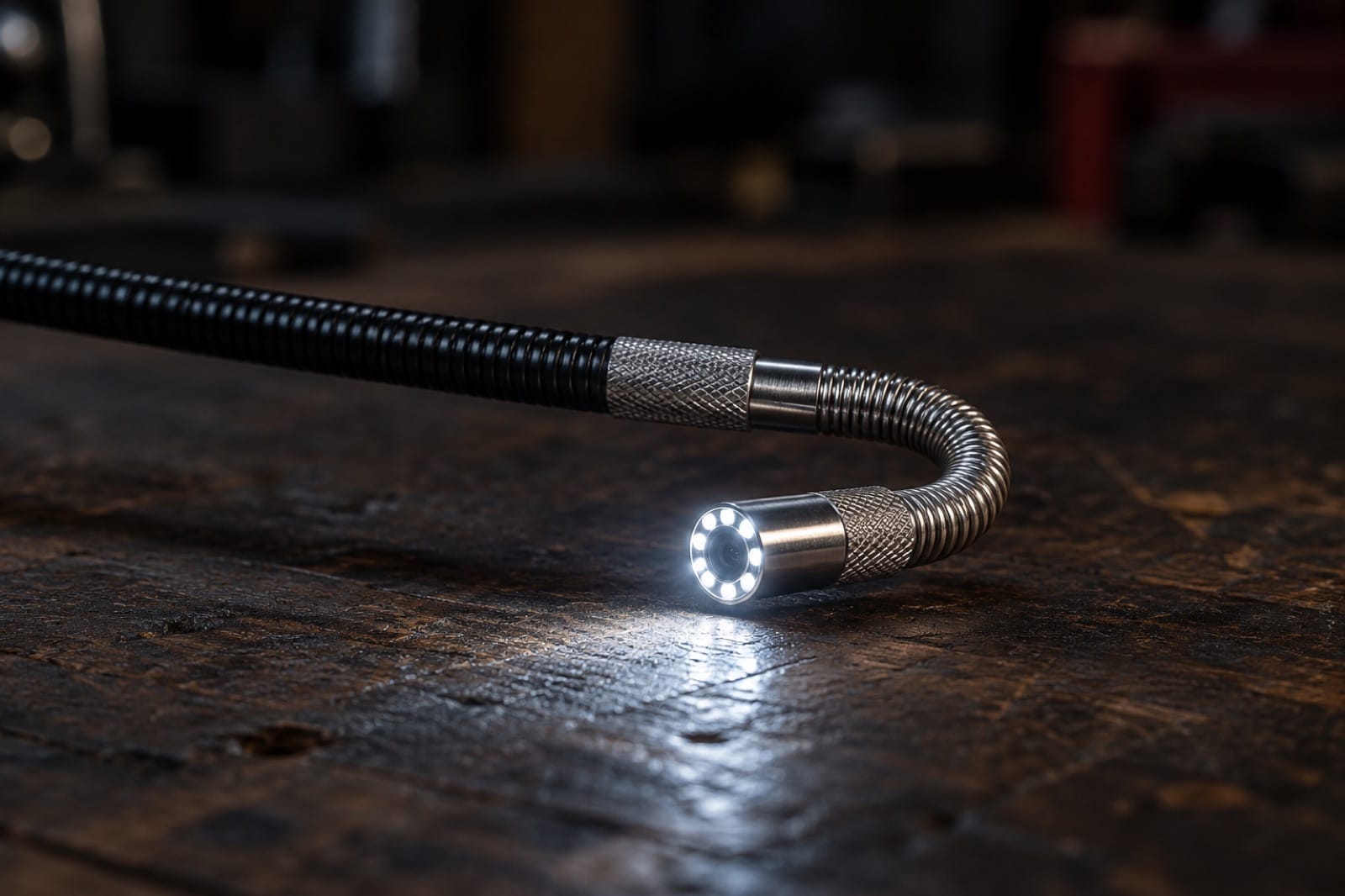
- Night vision collects light that is already there, or that it adds itself. Classic image-intensifier goggles amplify the faint starlight and moonlight bouncing off objects. Digital night vision, the kind in most security and trail cameras, uses a sensitive camera chip plus its own near-infrared LEDs: a ring of faint red dots around the lens. Either way, it sees reflected light, like a normal camera in very dim conditions.
- An infrared thermometer measures the heat radiation coming off a surface and turns it into one number. One spot, one reading. The red laser only shows you where it's pointing; it doesn't measure anything.
- A thermal camera measures the same heat radiation as the thermometer, but with a grid of thousands of tiny sensors, one reading per pixel, many times a second. The result is a picture where every point has a temperature.
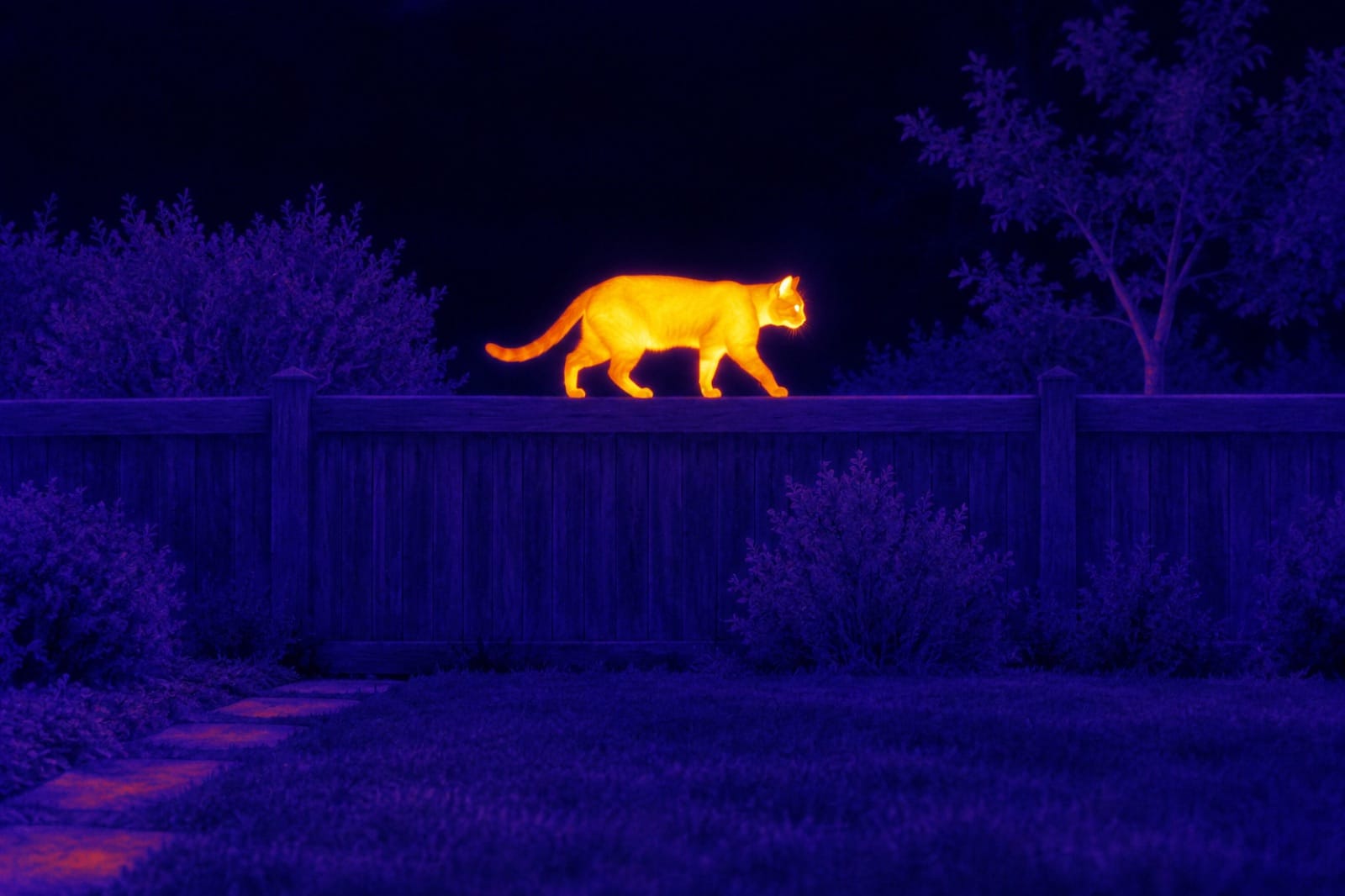
The key idea: everything warmer than absolute zero gives off infrared radiation, and the warmer it is, the more it gives off. People, pets, pipes, walls and coffee mugs all glow in this "light". A thermal camera doesn't need a lamp, the moon or an LED, because the things it looks at are their own light source.
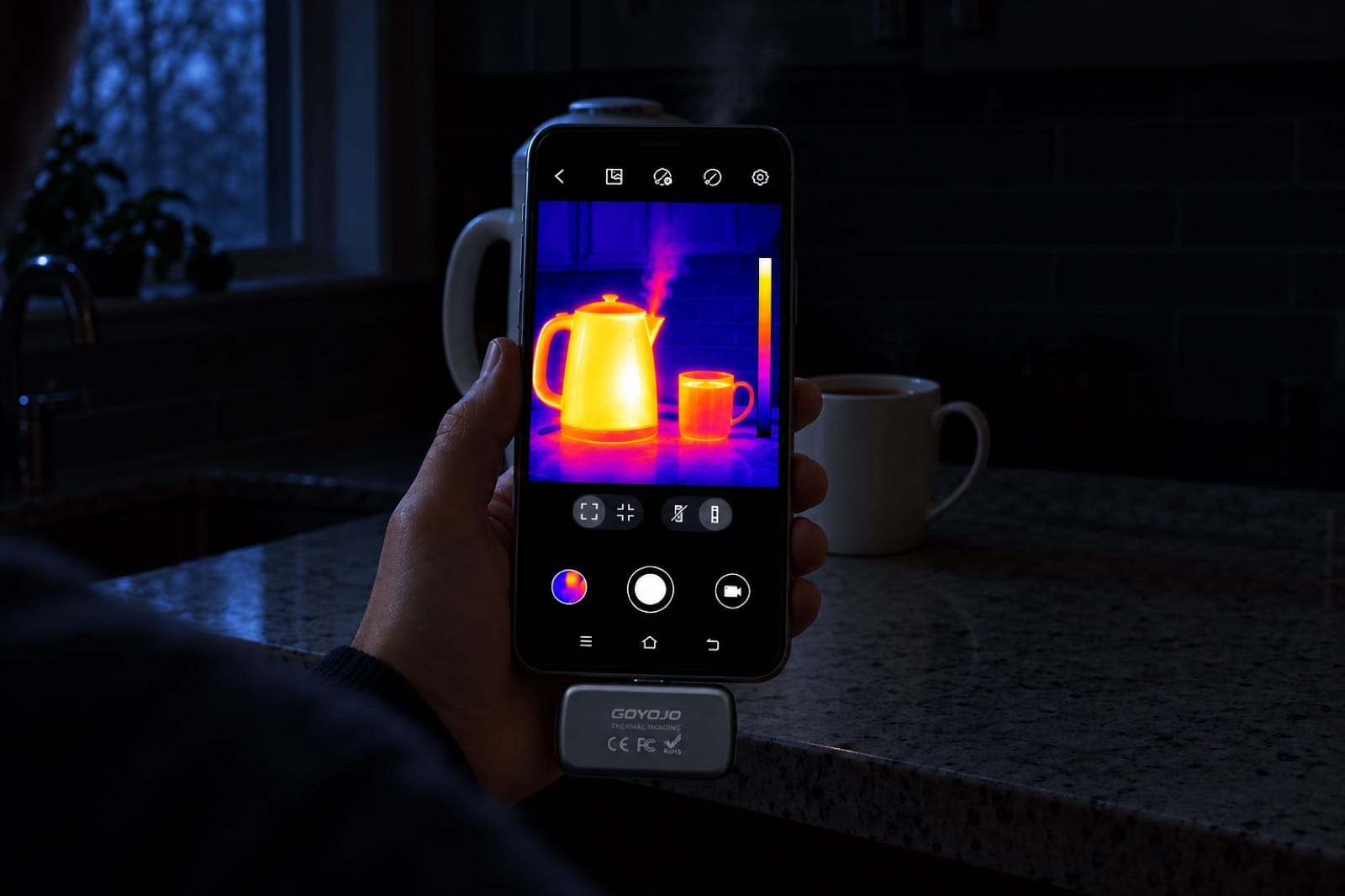
Illustration: the lights are off, but the thermal image is clear. A thermal camera reads the heat things give off, so it needs no light at all.
What wavelengths do they use?
Visible light runs from about 0.4 to 0.7 micrometers (µm). Night-vision illuminators, TV remotes and the "IR" in security cameras sit just beyond red, in the near infrared, roughly 0.7 to 1 µm. That is still reflected light; it behaves much like ordinary light.
Objects at room temperature give off most of their radiation much farther out, around 10 µm. That follows from a basic physics rule (Wien's law): at 68 °F (20 °C) the peak lands close to 10 µm, and at body temperature a little shorter. So thermal cameras and infrared thermometers are built for the long-wave band, roughly 8 to 14 µm, where houses and bodies are brightest. For more on the sensor itself, see how a thermal camera works.
That's why you can't turn a phone camera into a thermal camera with an app. Its chip simply isn't sensitive at 10 µm. Our guide to whether an iPhone has a thermal camera goes into this.
How do night vision, thermal and IR thermometers compare?
| Night vision | Infrared thermometer | Thermal camera | |
|---|---|---|---|
| What it senses | Reflected visible and near-infrared light | Heat radiation from one spot | Heat radiation from the whole scene |
| Needs some light? | Yes, or its own IR LEDs | No | No |
| What you get | A gray or green picture | One temperature | A temperature picture |
| Sees through a window? | Yes | No, it reads the glass | No, it reads the glass |
| Reads temperature? | No | Yes, one average value | Yes, at every pixel |
| Finds a cat in a dark bush? | Only if light reaches it | Only by luck | Yes, as a warm shape |
| Reads a license plate or a face? | Yes | No | Usually not |
Neither of the heat-based tools sees through walls. They read the temperature of the surface in front of them.
Is an infrared thermometer as good as a thermal camera?
For one job, yes. For most others, no, and the reason is what we call the spot problem.
An infrared thermometer looks simple: point, pull the trigger, read the number. The catch is in the small print on the box: the distance-to-spot ratio. A common figure on budget models is 12:1, meaning that from 12 inches away the reading covers a circle about 1 inch wide.
From across a room, that circle gets big. At about 10 ft (3 m) with a 12:1 ratio, the thermometer averages everything inside a circle about 10 inches (25 cm) wide. Point it at a window corner and the number blends glass, frame, wall and maybe a draft into one value. A cold strip less than an inch wide disappears into the average.
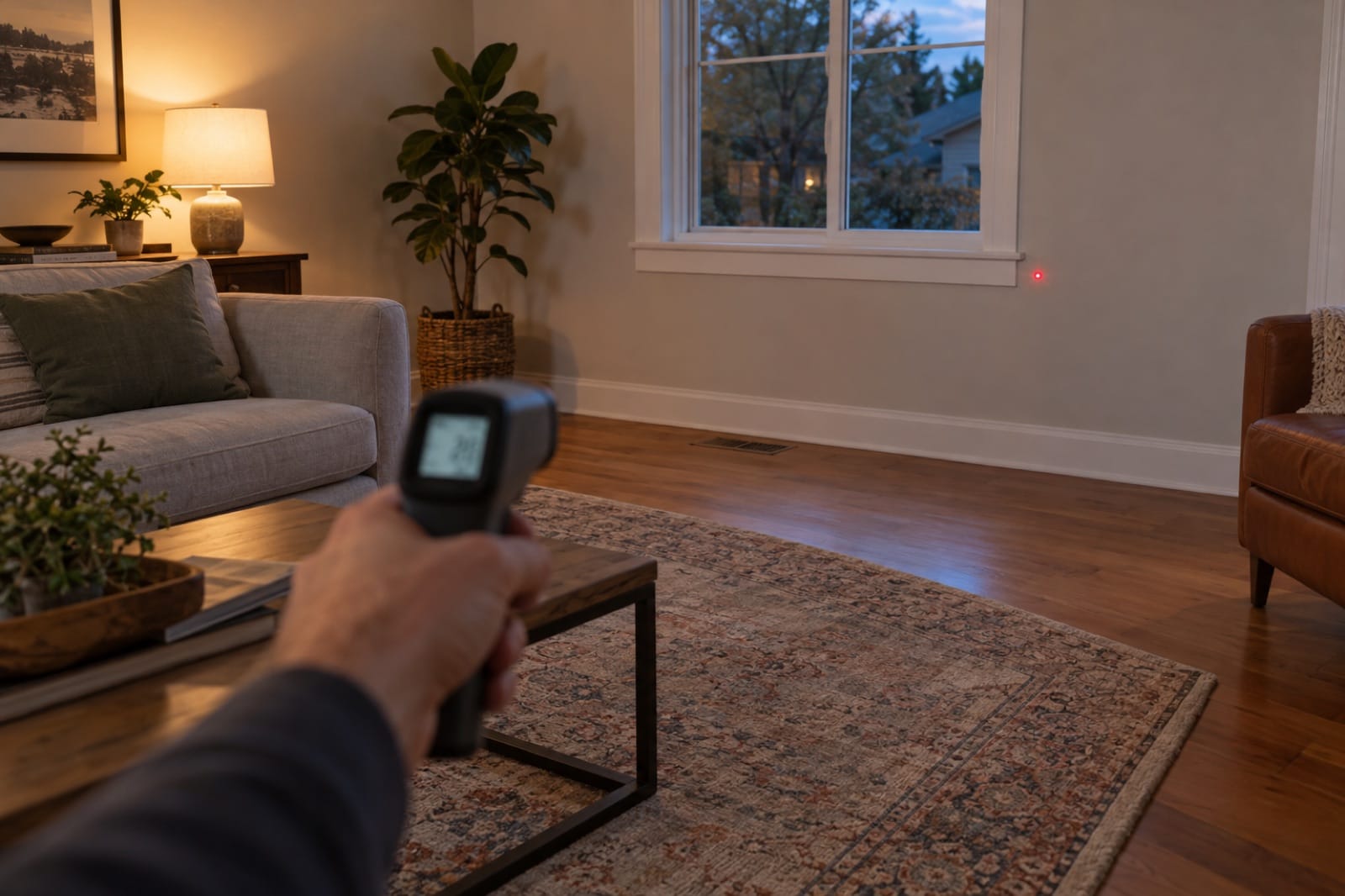
Illustration: the laser only shows where you're aiming. From 3 m, a 12:1 thermometer averages a circle about 25 cm wide around the dot.
There's a second problem: you only measure where you point. To find a cold spot on a wall with a thermometer, you'd have to sweep it inch by inch and remember every number. A thermal camera takes all of those readings at once and lays them out as a picture, so the cold strip, the warm pipe or the missing piece of insulation simply shows up as a shape.
Infrared thermometers are still useful for one known spot you can get close to: the temperature of a pan, an oven door, a hot water pipe you can reach. For anything where the question is "where?", a thermal camera is the right tool.
Both share the same weaknesses. Shiny metal, glass and glazed tile reflect heat, so either tool can read a reflection instead of the surface. Our guide to reading a thermal image covers reflections and emissivity in detail.
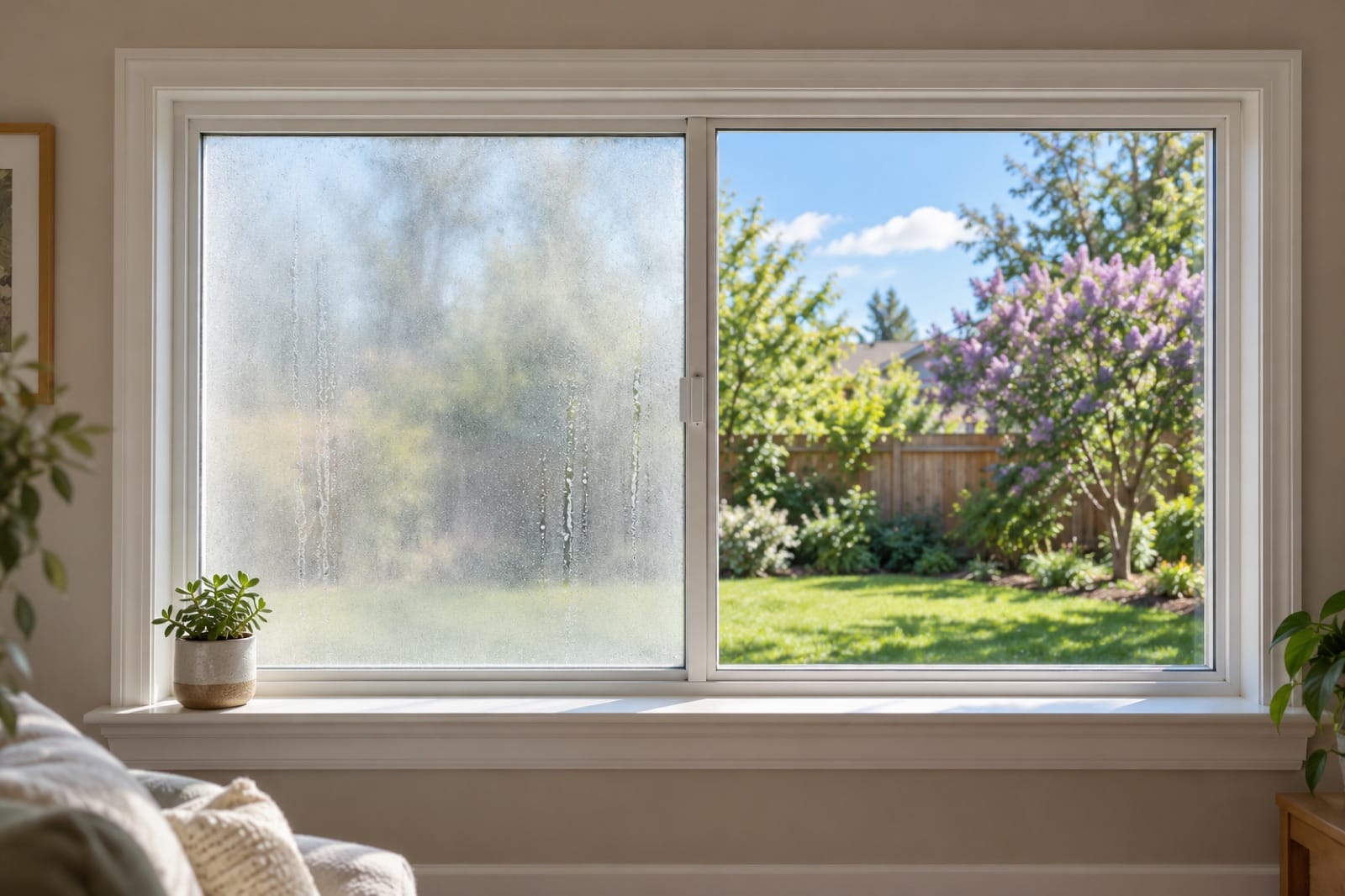
Can thermal or night vision see through a window?
Here's a quick way to feel the difference. Stand inside at night and point each tool at a window.
- Night vision looks straight through the glass into the backyard.
- The infrared thermometer gives you the temperature of the glass, not the backyard.
- A thermal camera shows the window as a flat, cool surface, often with a blurry warm reflection of you in it.
Ordinary glass blocks long-wave infrared almost completely and reflects part of it. That's also why thermal cameras use lenses made of special materials, such as germanium, instead of glass. It's the same reason you can't scan the outside of your house through a closed window: step outside, or open it.
One catch for security cameras: IR LEDs behind a window usually bounce back off the glass and wash out the picture, so night vision through a window works best when the light is coming from outside.
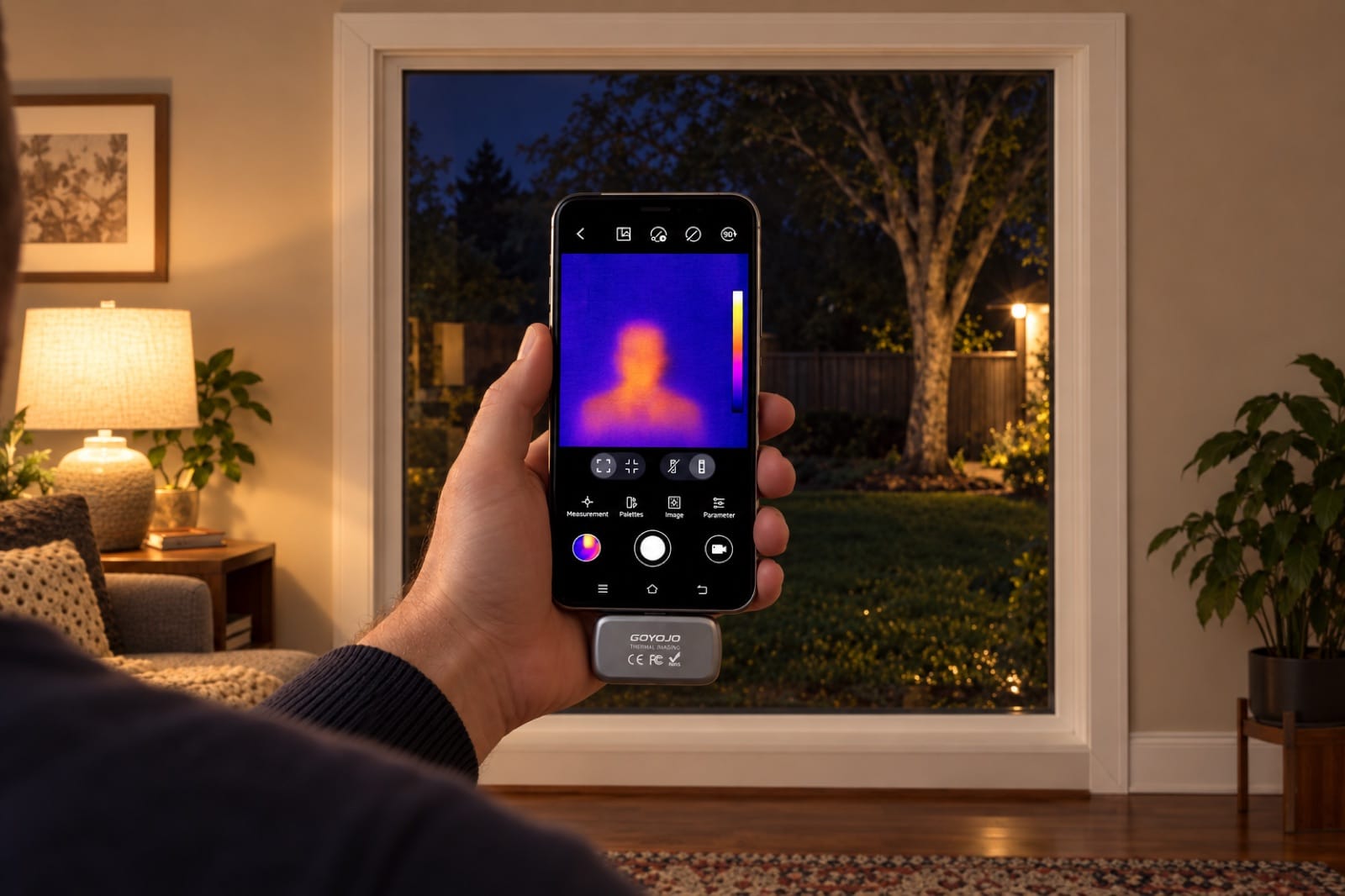
Illustration: the backyard is right there, but the thermal camera can't see through glass. It shows the glass itself and a warm reflection of you.
Which is better, thermal vision or night vision?
Neither is better overall. It depends on the question you're asking.
- Watching the driveway or the back door at night: night vision. A security camera with IR LEDs shows faces, clothes and license plates. A thermal camera tells you something warm is there, but not who.
- Spotting an animal in the dark backyard: a thermal camera. A possum in a tree or a cat under a bush stands out against the cooler nighttime yard, even half-hidden by leaves, with no light at all.
- Checking one surface you can touch: an infrared thermometer is fine and cheap.
- Finding drafts, missing insulation, hot pipes, damp patches or an overheating outlet: a thermal camera. These problems are shapes on a surface, and you need the whole picture to see them. Our guides to finding a water leak behind a wall and hot outlets and power strips show what those shapes look like.
What a thermal camera won't do: see through walls or glass, see water directly (wet surfaces usually read cooler because water evaporates), or tell you why a spot is warm. It shows where to look; the rest is up to you and, often, a second tool.
What are the downsides of thermal imaging and night vision?
Each one has limits that are easy to miss until you've bought it.
Thermal imaging:
- Little fine detail. You get shapes, not faces or text, and thermal sensors have far fewer pixels than an ordinary camera.
- It needs a temperature difference. When everything in view is about the same temperature, the picture turns flat, even if the objects are very different.
- Surfaces only. It reads the outside of whatever it's aimed at, and shiny surfaces can show a reflection instead.
Night vision:
- No temperature at all. It can't show you a hot pipe, a cold wall or a warm outlet.
- It depends on light. Without enough ambient light or an illuminator, the picture goes dark, and an illuminator only reaches so far.
- Bright lights get in the way. A porch light or headlights can wash out part of the image.
- Hiding works. An animal or person in deep shadow behind leaves can blend in, where a thermal camera would still pick up the warmth.
For home inspection, those limits point the same way: night vision has little to offer indoors, while the limits of thermal are ones you can work around by comparing surfaces and using a second tool.
Thermal cameras that plug into your phone
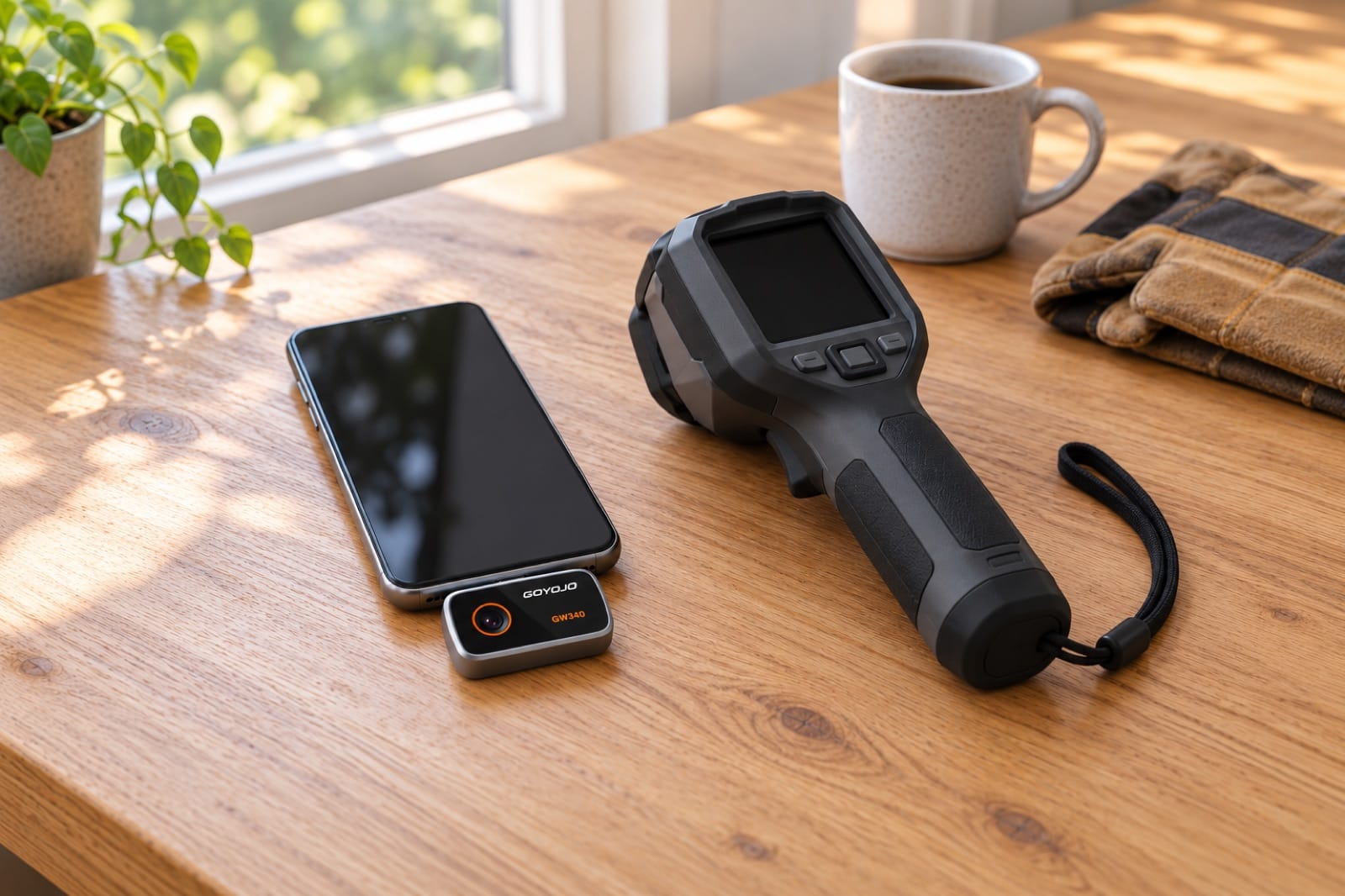
Our two thermal cameras are long-wave thermal imagers that plug into a USB-C phone and use the free THG Start app.
- Spark Pro (GOYOJO GW340) measures 256 × 192 thermal pixels, about 49,000 readings in every frame, at 25 frames per second, from −20 to 350 °C. Sharp enough to see a single 15 mm pipe from about 1.4 m.
- Spark (GOYOJO GW192A) measures 96 × 96 thermal pixels, shown as 192 × 192 on screen, from −20 to 400 °C, with ±2 °C or ±2 % accuracy. Best when you can get close to the surface.
Not sure which one fits you? Our Spark vs Spark Pro guide compares them job by job. If you use an iPhone, start with our guide to the thermal camera for iPhone.
Frequently asked questions
Can thermal vision see through walls?
No. A thermal camera reads the temperature of the surface in front of it, not what's behind. It can only hint at what's inside a wall when that thing changes the surface temperature, as a hot pipe warms the drywall in front of it. Films make this look far more dramatic than it is. A cold, dry object behind a wall usually leaves no trace.
Can you see at night with thermal?
Yes. A thermal camera works the same in total darkness as in daylight, because it reads the heat that objects give off rather than any light. It's good for spotting people and animals. It's not good for reading a sign or recognizing a face, and on a night when everything has cooled to about the same temperature, the scene can look flat.
Are thermal vision goggles real?
Yes. Head-mounted thermal devices exist and are used in fields such as firefighting and the military, though many everyday thermal tools are handheld units or modules that plug into a phone. Real ones don't work like the movies: the image shows heat patterns rather than a clear view through walls, and consumer versions usually have far less detail than a normal camera.
Is it legal to buy thermal goggles?
In many places, people can buy a thermal camera for use around the home, but the rules aren't the same everywhere. They can differ for hunting, for fitting a device to a weapon, and for taking one across a border. Check the rules where you live before you buy or travel. This isn't legal advice, so ask a local authority if you're unsure.
Can night vision see in total darkness?
Not by itself. Image-intensifier night vision needs at least a little ambient light to amplify, such as starlight. Digital night vision needs its own near-infrared LEDs, and it sees only as far as they reach. In a sealed dark room with no illuminator, there's nothing to amplify. A thermal camera doesn't have that problem, because the objects themselves give off the radiation it reads.
The tools in this guide
Prices are on each product page, in your local currency.
- Spark Pro — 256 × 192 thermal pixels, a whole wall or ceiling in one frame.
- Spark — 96 × 96 thermal pixels, the same app and colors, for close-up checks.
Ready to see heat for yourself? Order Spark Pro and turn your phone into a thermal camera.