How to find a roof leak from inside the house
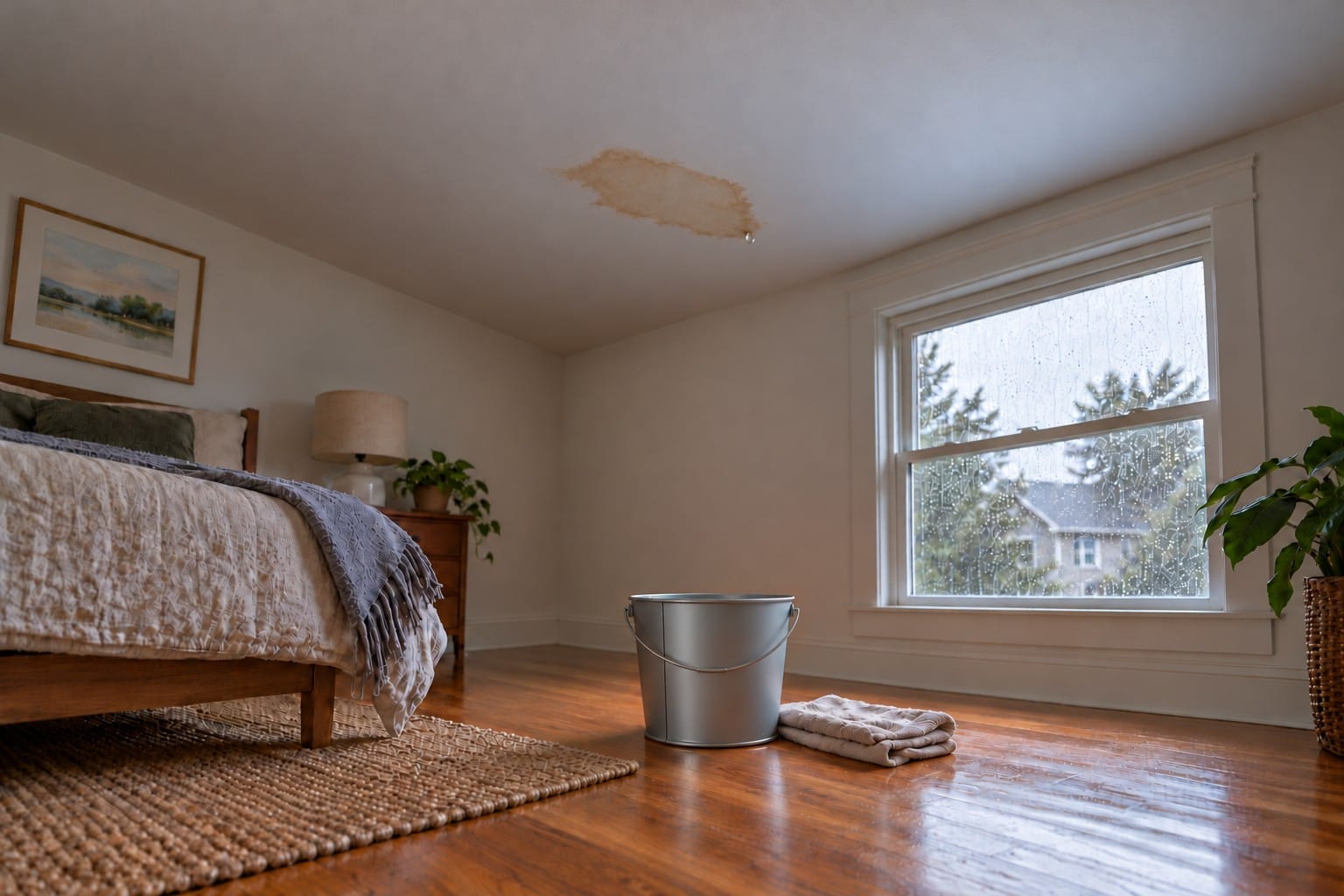
A storm rolls through, the gutters overflow for twenty minutes, and the next morning there's a brown ring on the bedroom ceiling. The obvious guess is a broken shingle right above it. Often that guess is wrong, and that's the catch in learning how to find a roof leak: water gets in at one point, runs down the underlayment, a rafter or the top of the insulation, and drips where gravity finally lets go, sometimes several feet away.
Short answer: To find a roof leak from inside, start at the ceiling stain while it's still wet. Map the full wet area with a thermal camera, confirm it with a moisture meter, then go up to the attic and follow the water trail uphill to where it enters. Give the roofer that exact spot.
You can't fix a roof from inside, but you can work out where the water really travels before anyone climbs up.
How do you find a roof leak from inside the house?
Roof leak detection doesn't have to start on a ladder. Work in this order: make it safe, rule out look-alikes, map the ceiling, confirm it's wet, follow the trail in the attic, then look from outside.
First, make it safe (5 minutes)
- A sagging, bulging ceiling is holding water. Don't stand under it. Put a bucket below, and if it keeps swelling, a small hole with a screwdriver at the lowest point lets the water drain into the bucket instead of bringing the drywall down.
- Water near a recessed light, a light fixture or a ceiling fan: switch that circuit off at the electrical panel and leave it off until a licensed electrician has looked at it (in most places this is required by law).
- Move furniture and rugs, and take photos of everything before you clean up. Most insurers want to see the damage as you found it.
How do you know you have a roof leak?
Look for a brown ring or bubbling paint on a ceiling, damp along the top of an outside wall, or a musty attic. A ceiling stain after a storm is usually the roof or the gutters, but not always. Take 10 minutes to rule out the look-alikes:
| What you notice | More likely cause |
|---|---|
| Appears only in heavy downpours, along an outside wall | Gutters overflowing back under the roof edge |
| Appears in every rain, even light rain | A cracked or missing shingle or tile, the ridge cap, or flashing |
| Worse when wind drives rain from one side | Flashing around a chimney, skylight, vent or wall junction |
| Appears after a shower or when the toilet upstairs is used | Plumbing, not the roof |
| Appears on hot days near an AC air handler in the attic | A blocked or leaking condensate drain |
| Appears near the water heater in the attic | The tank, its fittings or its relief valve drain |
If the stain doesn't fit the weather, our guide to finding a water leak behind a wall covers the plumbing side, and if it's under an indoor AC unit, check that unit's condensate drain.
Can you see a roof leak with a thermal camera?
You can see what it leaves behind. Take about 5 minutes while the ceiling is still wet: during the storm or within a day after it.
Wet drywall reads cooler than dry drywall next to it, because the water in it is slowly evaporating. A thermal camera doesn't see the water and doesn't see through the ceiling; it shows that cooler patch on the surface. That's useful, because the patch is almost always bigger than the stain you can see, and its shape points to where the water came from.
- Scan the whole ceiling, not just the stain, then the tops of the walls. Water often runs along a ceiling joist and shows up as a narrow cool strip leading away from the stain.
- Follow the strip. It usually leads toward the outside wall, the gutter line or the roof penetration the water came in through.
- Check the rooms next door and the closet. Two stains from one leak are common.
- On a hot afternoon, the attic heats the whole ceiling from above. The wet patch still stays cooler, often with even more contrast; just make sure you compare it with dry ceiling in the same room.
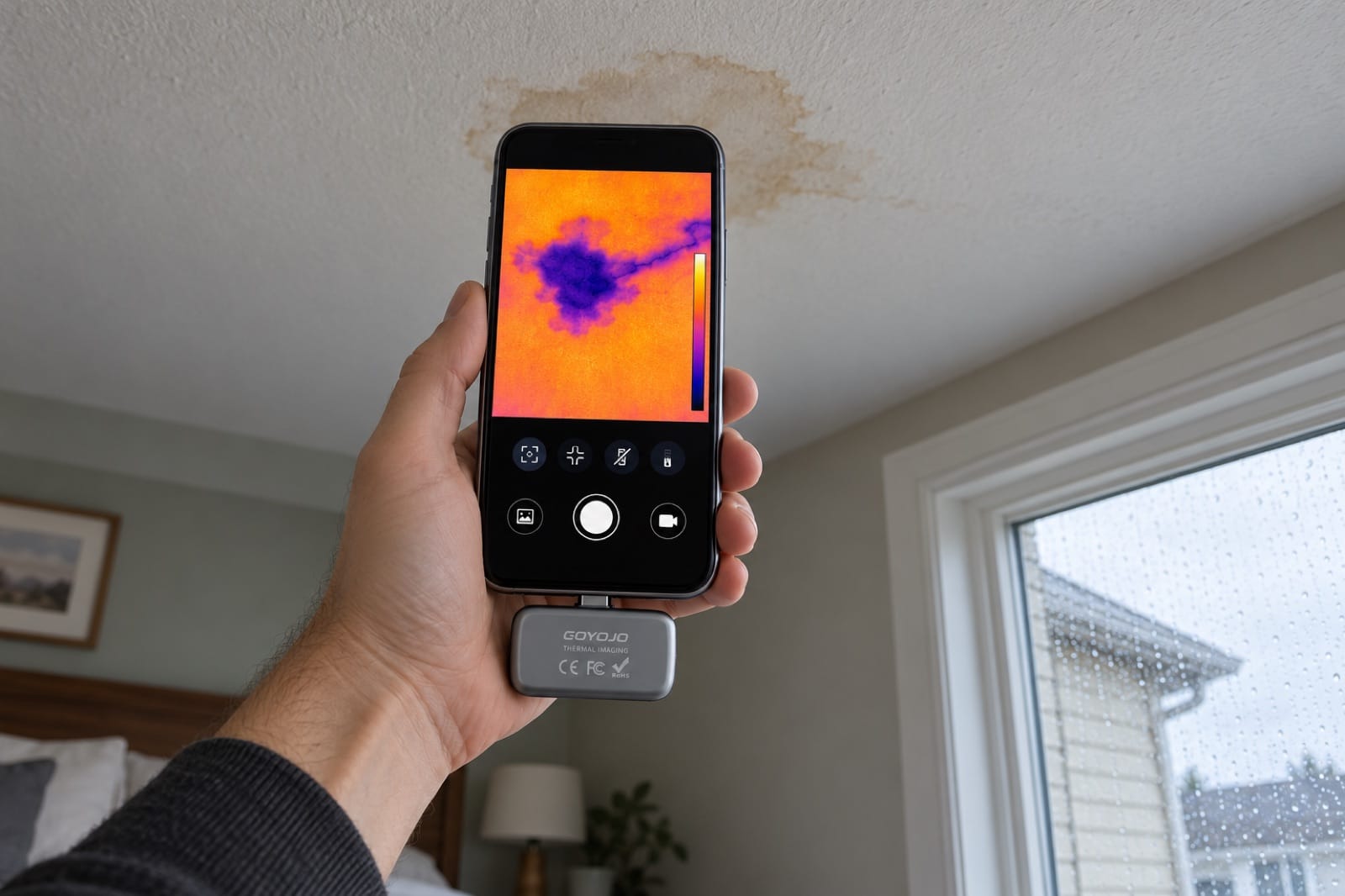
Illustration: the wet area is bigger than the stain, and the cool strip along a joist points toward where the water came from.
From floor level, the ceiling is about 8 feet away. That's where resolution matters: Spark Pro shows a narrow cool strip along a joist from where you stand, while Spark works too but you'll want a step ladder to get closer. Our Spark vs Spark Pro guide has the distances, and thermal cameras for iPhone explains how these phone add-ons work.
One trap: a missing or shifted insulation batt also shows up as a patch with a different temperature, usually with straight edges. That's why the next step matters.
Is that cool patch actually wet?
A thermal camera says "cooler". A moisture meter says "wet" or "not wet". This takes about 5 minutes.
- Take a reading on a part of the ceiling that's clearly dry. That's your baseline.
- Move toward the stain in small steps and watch the number climb.
- Mark the wettest point and the edge of the wet area with painter's tape.
With a pinless moisture meter like Damp, the reading comes from 5–40 mm into the drywall, without leaving holes. Ceilings have screws, metal trim and sometimes metal furring, and metal behind the surface makes the reading jump. If one spot spikes and the area around it doesn't, move a few inches and measure again.
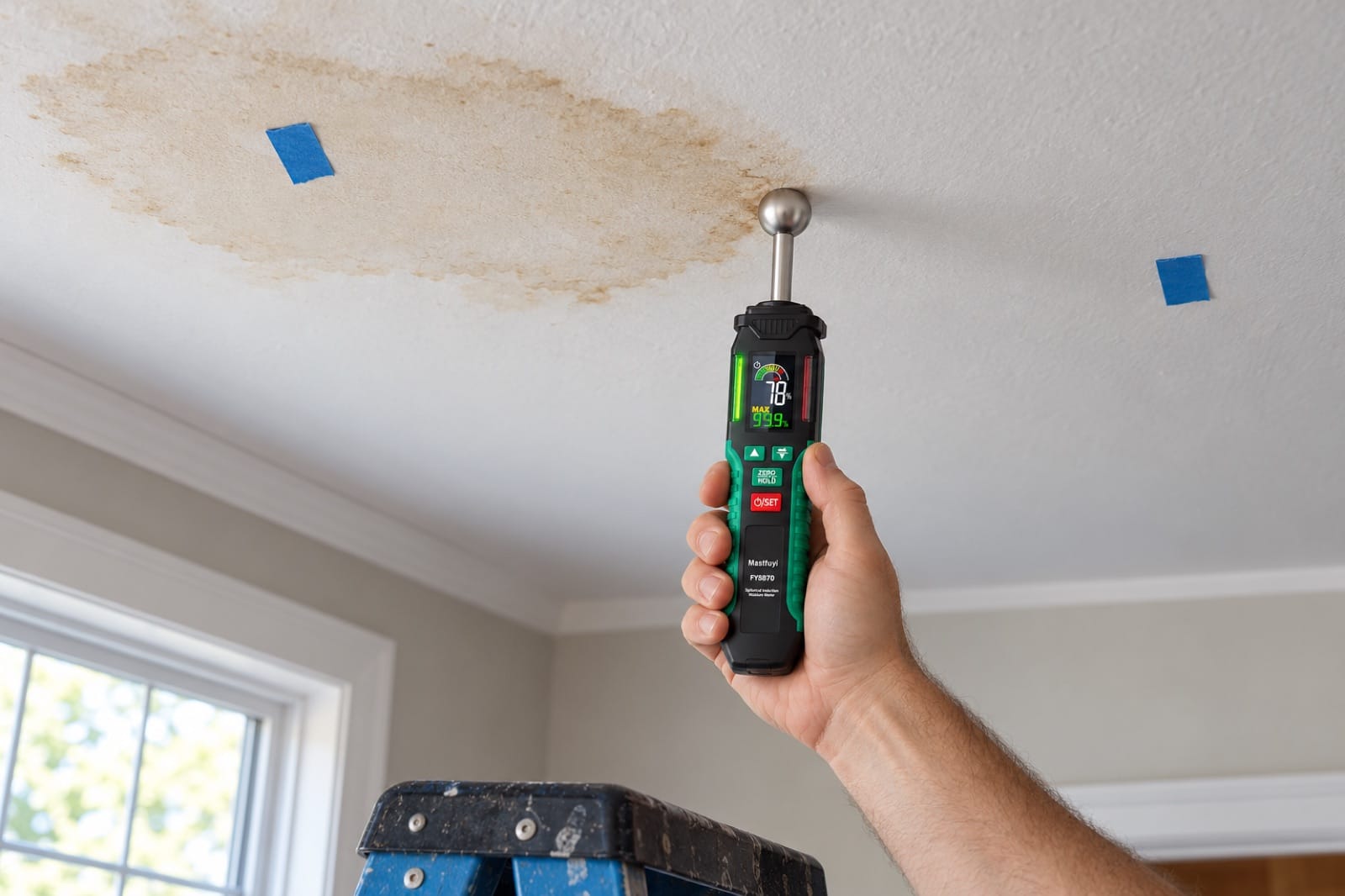
Illustration: start on dry ceiling, move toward the stain and tape the readings. The difference matters more than the number.
Write the readings on the tape with the date. Measure the same spots after two or three dry days. If the numbers fall, the leak only runs in rain; if they stay high, look for a plumbing source again.
How do you trace a roof leak in the attic?
If you can get in through the attic hatch, allow about 15 minutes. This is where the trail usually ends.
- Go early in the morning. On a summer afternoon an attic can get dangerously hot. Take water, a headlamp and a dust mask for the insulation fibers.
- Step only on the ceiling joists or on boards laid across them, never on the drywall between them. Watch for cables, and keep clear of anything that looks damaged.
- Stand above the stain and work uphill from there. Look at the underside of the roof, the underlayment, the rafters and the top of the insulation.
- Scan with the thermal camera. Wet wood and wet underlayment read cooler than the dry wood around them, and a streak running down a rafter points straight back to where the water gets in. Daylight showing through the roof deck or between tiles is another clue.
- Look closely at the usual entry points: damaged shingles or slipped tiles, the ridge, valleys, flashing around vent pipes, chimneys, skylights and solar panel mounts, and the line above an overflowing gutter.
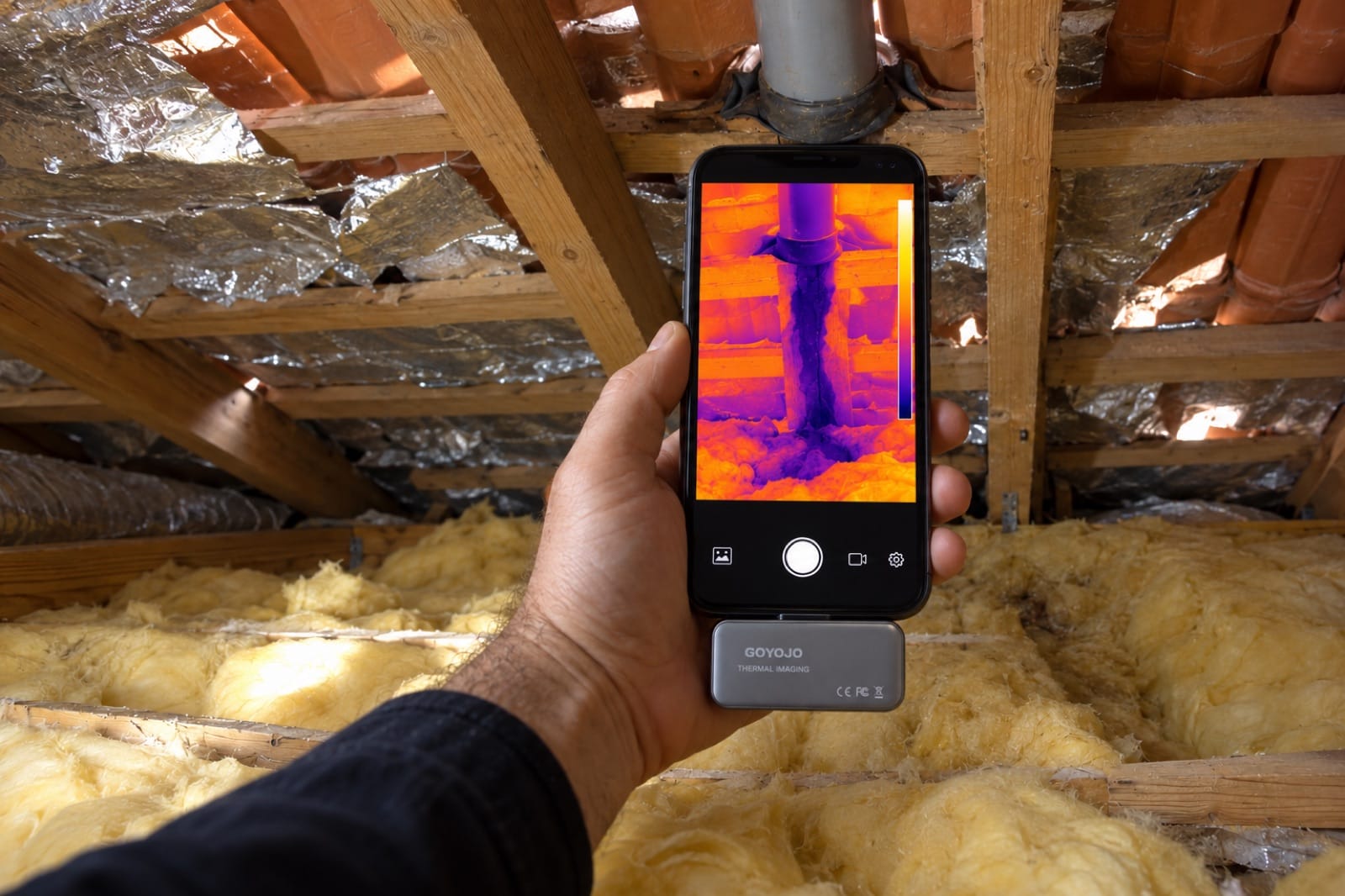
Illustration: wet wood and insulation read cooler than dry. The streak starts at the flashing around the vent pipe, so that's where the water gets in.
Check the insulation where the streak ends. Wet batts lose much of their insulating value and should be dried or replaced once the leak is fixed.
If the attic is too low or tight to move around safely, stop here. What you've mapped from the room below is already enough for a roofer.
How do you find a roof leak from the outside?
Stay on the ground. A wet or steep roof is a job for a pro, and binoculars from across the yard show plenty. Look uphill of the spot you marked indoors, not straight above it:
- Missing, cracked or curled shingles, or slipped tiles.
- Flashing that's lifted, rusted or pulled away around a chimney, vent or skylight.
- Valleys and gutters packed with leaves, and gutters pulling away from the house.
- Dark streaks on the siding below a gutter, which point to overflow.
Measure the wet spot from two inside walls, then find the same position from outside. That tells you which part of the roof to study first.
Common mistakes when you trace a leak
- Looking only straight above the stain. Water travels, so the entry point is usually higher up the slope.
- Painting over the stain first. You lose the mark you're tracking.
- Smearing sealant over the first gap you see. It can hide the real entry point from the roofer.
What should you tell the roofer?
Roof repairs belong to a roofer. Wet roofs are slippery, and a hose test needs someone up there and someone inside, so let the pro run it. What you bring saves a lot of guessing:
- A photo of the stain, plus a thermal photo showing the full wet area and any strip leading away from it.
- Where the wettest point is, measured from two walls.
- Attic photos of the wet wood and the shingle, tile, flashing or gutter above it.
- When it leaks: every rain, only heavy downpours, only with wind from one side.
After the fix: dry, then check
- Let the ceiling dry fully before you paint. Measure the taped spots again; when they read the same as your dry baseline, it's dry.
- Water stains bleed through ordinary paint. A stain-blocking sealer first, then paint.
- Scan the same ceiling again after the next big storm. An even ceiling on the thermal camera and a steady moisture reading mean the repair worked.
If a ceiling stayed wet for weeks, check it for mold too; our guide to damp and mold covers what to look for.
What these tools can't do
- A thermal camera can't find a leak that has dried out. It needs the wet patch to be there, so scan soon after the storm.
- It doesn't see through the ceiling or the roof, only the surface in front of it.
- A cooler patch alone doesn't prove water; insulation gaps can look similar. The moisture meter settles it.
Frequently asked questions
How do you find a water leak that isn't visible?
A leak can wet attic insulation or the back of the drywall before any stain shows. Scan ceilings and the tops of walls with a thermal camera soon after rain, then check any odd patch with a moisture meter. In the attic, look for darkened wood, matted insulation and rusty nail tips.
How long can a roof leak go undetected?
Often weeks or months, and there's no fixed number. A slow leak can soak insulation and wood for a long time before the drywall below shows a stain, especially if it only runs in wind-driven rain. That's why a look in the attic after a big storm is worth the few minutes.
Why does my roof only leak in heavy rain?
Usually because the water is reaching a spot that light rain never touches. Common causes are gutters overflowing back under the roof edge, valleys packed with debris, and flashing that only lets water past when wind pushes it sideways. Write down the wind direction and how long it rained before the drip started, and tell your roofer.
How do you find a roof leak without attic access?
With a cathedral ceiling or no attic you can enter, work from the room below. Scan the ceiling with a thermal camera while it's wet, confirm the patch with a moisture meter, and tape the wettest point. Then check the matching part of the roof from the ground. A roofer can take it from there with a water test.
The tools in this guide
Prices are on each product page, in your local currency.
- Spark Pro — sees a wet patch and the strip along a joist on a ceiling from floor level.
- Spark — the same app and colors, for close-up checks from a ladder.
- Damp — pinless moisture meter, reads 5–40 mm into drywall and wood without holes.
Find the wet patch before it spreads. Order Spark Pro, and add Damp to confirm what's wet and know when it's dry.